



Executive Summary: The Evolution of High-Density Storage in Poland’s Logistics Axis
The Republic of Poland has firmly consolidated its position as the undisputed logistical heartland of Central and Eastern Europe (CEE). Positioned along crucial Trans-European Transport Network (TEN-T) corridors—including the Baltic-Adriatic Corridor and the North Sea-Baltic Axis—Poland serves as a key gateway for international trade, pan-European e-commerce distribution, and manufacturing nearshoring. Major industrial nodes such as Upper Silesia (Katowice/Gliwice), Central Poland (Łódź/Piotrków Trybunalski), Greater Poland (Poznań), Lower Silesia (Wrocław), Warsaw Metropolitan Area, and the maritime gateway of the Tricity (Gdańsk/Gdynia) are witnessing unprecedented expansion in warehouse inventory.
However, this structural growth has brought acute challenges: prime industrial land cost escalation, surging warehouse rental rates per square meter, increased energy tariffs for cold storage operations, and a tightening industrial labor pool. To maintain competitive operational margins, Polish logistics managers, 3PL providers, and manufacturing plant directors are aggressively transitioning from traditional, low-density selective pallet racking to advanced High Density Storage Systems.
Key Market Insight: Implementing automated high-density storage solutions (such as Pallet Radio Shuttle and Multi-Tier Structural Mezzanines) increases floor volume utilization from standard 40-45% up to 80-85%, effectively doubling pallet slot capacity without expanding the structural footprint of the warehouse building.
As a premier OEM/ODM direct factory and exporter specializing in heavy-duty structural steel material handling equipment, our organization supplies engineered, EN-standard compliant storage systems explicitly optimized for Polish building codes, fire protection regulations (ITB guidelines), and severe operational conditions such as sub-zero cold-chain warehousing.
Engineering Architecture & Structural Classifications of High-Density Systems
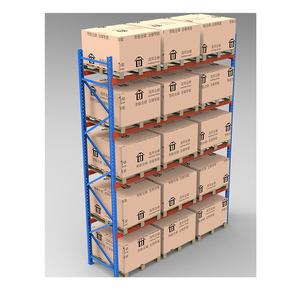
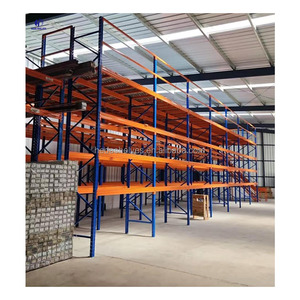
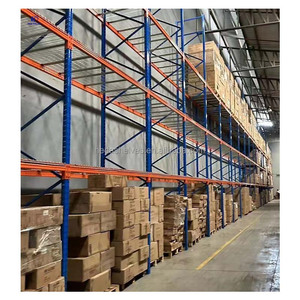
Selecting the optimal high-density storage layout requires a thorough structural analysis of unit load characteristics, SKU turnover rates, picking dynamics, and building constraints. Below is an engineering evaluation of the primary high-density system topologies exported to the Polish market.
1. Semi-Automated Radio Shuttle Pallet Racking
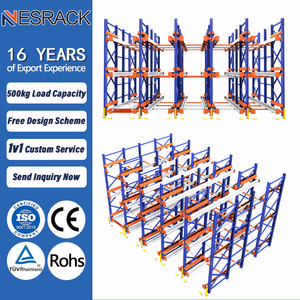
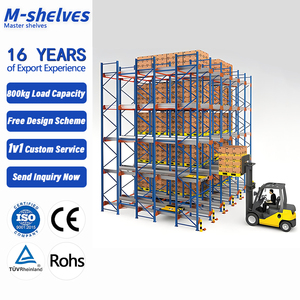
The Radio Shuttle System represents the pinnacle of high-density deep-lane storage. The configuration utilizes dynamic self-propelled shuttle carts running inside dedicated channel rails positioned under the pallet bays. Controlled via Wi-Fi radio remotes or integrated WMS (Warehouse Management System) interfaces, the shuttle carries 800x1200mm Euro-pallets or 1000x1200mm Industrial pallets deep into the racking matrix.
This system seamlessly supports both FIFO (First-In, First-Out) and LIFO (Last-In, First-Out) inventory protocols. By eliminating the need for forklifts to enter the racking channels, structural upright damage is reduced by over 90%, while throughput speed is increased by 40% compared to traditional drive-in configurations.
2. Drive-In & Drive-Through Racking Systems
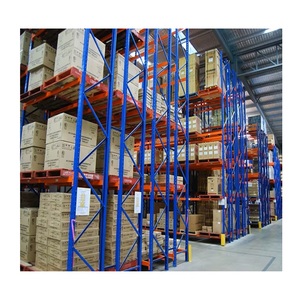
Designed for homogeneous inventory profiles with low SKU variety but massive pallet quantities per line. Forklifts drive directly into the racking blocks to deposit or retrieve pallets resting on continuous side cantilever rails. Engineered with structural tie-beams and top-bracing frames, our drive-in systems utilize S355JR structural cold-rolled steel profiles to ensure extreme frame rigidity under maximum heavy loads.
3. Mezzanine Floor Platforms & Multi-Tier Shelving
To fully leverage vertical clear height in modern Polish logistics parks (often featuring clear heights of 10 to 12 meters), heavy-duty steel platform mezzanines create entirely new elevated floor levels. Supported by robust structural steel columns (H-beams/square hollow sections) and cold-formed C/Z purlins, these multi-tier structures can support uniform live loads ranging from 300 kg/m² up to 1,500 kg/m². They are widely integrated with carton live storage, boltless shelving, and automated conveyor loops for e-commerce order picking.
4. Automated Storage and Retrieval Systems (AS/RS) & 4-Way Shuttles
For fully automated Industry 4.0 Smart Warehouses, our 4-Way Radio Shuttle and AS/RS high-bay racking systems offer precision engineered structural tolerance (+/- 1.5mm variance), providing reliable interface points for robotic stacker cranes, AGVs (Automated Guided Vehicles), and vertical lifts.
High-Grade European Steel
Manufactured using certified S355JR / S420 structural steel profiles, offering superior tensile strength, beam deflective limits, and impact resistance compared to standard Q235 steel profiles.
EN 15512 Structural Safety
Engineered strictly according to European Standard EN 15512 for structural design of adjustable pallet racking, fully compliant with FEM 10.2.02 and EN 15635 rack inspection codes.
Sub-Zero Cold Coating
Advanced thermosetting epoxy-polyester powder coating (60-80μm thickness) or Hot-Dip Galvanizing (EN ISO 1461) preventing micro-cracking and corrosion in cold storage down to -30°C.
Comparative Analysis Matrix: Storage Efficiency & ROI for Polish Operators
To assist warehouse developers, procurement directors, and logistics engineers in selecting the correct system layout, the table below provides a comparative performance evaluation across major high-density engineering topologies.
| Storage System Type | Floor Area Utilization | Pallet Selectivity | Operative Forklift Cost | Estimated Cost per Pallet Slot (€) | Typical ROI Horizon (Poland) |
|---|---|---|---|---|---|
| Selective Pallet Racking | 40% - 45% | 100% (Direct) | Standard Counterbalance / Reach | €35 - €55 | Baseline |
| Radio Shuttle System | 80% - 85% | Low-Medium (Batch) | Standard Forklift (Outside Rack) | €90 - €140 (inc. Shuttle) | 14 - 22 Months |
| Drive-In Racking | 65% - 75% | Very Low (LIFO) | Specialized Narrow Drive-In Truck | €50 - €75 | 18 - 24 Months |
| Multi-Tier Mezzanine Platform | 150% - 250% (Usable Floor) | 100% (Hand Pick) | Manual / Order Picker / Conveyor | €70 - €120 / m² | 12 - 18 Months |
| Automated AS/RS (High-Bay) | 85% - 92% | 100% Automated | Robotic Crane / AGV (No Driver) | €250 - €450 (Turnkey) | 30 - 42 Months |
Localized Application Scenarios across Poland's Industrial Regions
Different industrial clusters in Poland require specific storage architectures dictated by regional commodity flows and supply chain characteristics. Our factory delivers customized layouts engineered for these localized operational environments.
1. Central Poland (Łódź & Piotrków Trybunalski) - FMCG & Cold Storage Hubs
Challenge: High throughput of perishable foodstuffs, frozen meat/dairy exports, and fast-moving retail goods requiring rapid fulfillment and strict temperature control.
- Solution: Hot-Dip Galvanized Radio Shuttle Racks operating at -25°C.
- Benefit: Minimizes cold room cubic volume, drastically reducing refrigeration energy consumption per pallet slot while ensuring compliant FIFO rotation.
2. Upper Silesia (Katowice, Gliwice, Tychy) - Automotive Nearshoring
Challenge: Storage of heavy automotive stampings, engine components, battery packs, and industrial raw materials with extreme point loads.
- Solution: Heavy-Duty Beam Racks and Structural Mezzanines with high load uprights (up to 24,000 kg frame capacity).
- Benefit: Safely supports dense metal gitterboxes and heavy pallets adjacent to automotive assembly lines.
3. Western Poland (Poznań, Wrocław, Słubice) - Cross-Border E-Commerce
Challenge: Massive SKU counts, rapid parcel picking, seasonal volume spikes serving both Polish and German consumer markets.
- Solution: Multi-tier mezzanine picking platforms combined with carton live storage flow tracks and safety wire mesh decking.
- Benefit: Multiplies manual order picking positions by 300% without expanding ground building footprints.
4. Pomerania & Baltic Coast (Gdańsk & Gdynia Ports) - Maritime Freight
Challenge: Rapid container de-stuffing, buffer storage, high ambient humidity, and saline coastal atmospheric exposure.
- Solution: Heavy-duty outdoor covered cantilever racking and specialized galvanized heavy racking.
- Benefit: Superior weather protection, corrosion resistance, and fast turnaround for sea container logistics.
Why Direct Manufacturing Export Matters: Enterprise Advantage
Procuring warehouse racking directly from our modern manufacturing facility provides substantial structural, technical, and financial advantages over local trading intermediaries:
Custom CAD & BIM Integration
Our in-house structural engineering team provides complimentary 2D DWG layouts and 3D BIM models fully compatible with Polish building permit applications (Prawo Budowlane).
Certified Quality Assurance
Every steel profile batch undergoes raw material spectral analysis, tensile testing, weld seam ultrasonic testing, and salt-spray powder adhesion tests (ISO 9001 quality management).
Direct Freight to Baltic Ports / Rail
Seamless door-to-door (DDP/DAP) sea container shipping via Baltic Hub Gdańsk/Gdynia or direct Silk Road rail express transport to Małaszewicze terminal in Eastern Poland.
Frequently Asked Questions (FAQ) for Procurement & Logistics Managers in Poland
Do your racking systems comply with Polish ITB fire safety and EN standards?
Yes. All racking systems exported to Poland are designed according to European structural standards EN 15512, EN 15620, EN 15635, and FEM 10.2.02. For fire protection compliance (ITB requirements), we supply open-aperture wire mesh decking (minimum 50% open area) to ensure unimpeded water penetration from ceiling ESFR sprinkler systems.
What concrete floor slab specifications are required for high-density racking?
For standard heavy-duty selective racking, a concrete slab class of C20/25 or C25/30 with a minimum thickness of 150-200mm is generally sufficient. For high-density Radio Shuttle systems and automated high-bay racking exceeding 10 meters in height, a slab class of C30/37 with steel fiber reinforcement meeting FM2 or Superflat floor tolerance standards (EN 15620) is recommended to handle concentrated point loads under upright footplates.
What are the lead times for manufacturing and delivery to Poland?
Standard factory production lead time is typically 20 to 25 days following engineering drawing approval. Ocean freight from our factory port to Port of Gdańsk or Gdynia takes approximately 30 to 35 days. Express rail freight via the Małaszewicze railway hub offers a faster transit time of approximately 14 to 18 days.
Can your factory provide compatible components for existing European racking brands?
Yes. We regularly manufacture cross-compatible upright profiles, beam connectors, and accessories matching major European profiles (such as 50mm and 75mm pitch hole patterns). Our engineering team can analyze your existing pitch photos and technical drawings to manufacture perfectly fitting add-on bays and replacement frames.
How are customs clearance and EU VAT handled for Polish buyers?
We offer flexible shipping terms including FOB, CIF, DAP, and full DDP (Delivered Duty Paid). Under DDP terms, our logistics partners manage all import customs clearance, tariff payments, and administrative formalities at the Polish border, allowing your company to receive cargo directly at your facility while handling VAT through standard NIP / EU-VAT accounting.