Factory Direct Catalog
Industrial Grade Storage Pallet Racking Systems
Certified high-capacity load systems optimized for distribution centers, automated facilities, and heavy-duty industrial logistics.
1. Technical Engineering Standards in Industrial Bulk Pallet Racking
In modern industrial logistics, specifying structural warehouse racking requires deep adherence to mechanical engineering principles and rigorous international standards. As a premier original equipment manufacturer (OEM) with over two decades of metallurgical and roll-forming expertise, our engineering framework integrates cold-formed structural steel design compliant with RMI (Rack Manufacturers Institute), ANSI MH16.1, and European FEM 10.2.02 / EN 15635 standards.
The structural integrity of heavy-duty pallet racking systems depends on structural geometry, connection rigidity, yield strength of raw steel profiles, and resistance to dynamic impact loading. Utilizing certified high-tensile hot-rolled coil steel such as Q235B and Q355B (SS400 / Grade 50 equivalent), our cold-roll forming processes produce upright columns with multi-fold rib configurations, significantly increasing section modulus ($Z_x$) and moment of inertia ($I_x$) without adding excess dead load to warehouse floor slabs.
Understanding the stress distribution across beam-to-upright connections is vital for long-span high-bay selective racks and drive-in configurations:
- Q235B Grade Steel: Yield strength $f_y \ge 235 \text{ MPa}$, Tensile strength $370-500 \text{ MPa}$. Optimized for standard load-bearing beams and general-purpose longspan shelving.
- Q355B High-Strength Alloy: Yield strength $f_y \ge 355 \text{ MPa}$, Tensile strength $470-630 \text{ MPa}$. Engineered specifically for automated high-bay AS/RS structures exceeding 20 meters in height and continuous dynamic loads up to 4,000 kg per level.
To eliminate sway modes and frame deflection under ultimate load conditions, our racking systems feature double-lug and triple-hook connector plates equipped with automatic safety locks. Mechanical safety pins prevent accidental beam dislodgement caused by forklift mast interference, maintaining total systemic safety under severe operational stresses.
2. Enterprise Manufacturing Capacities & Proprietary Finish Technologies
Our manufacturing complex houses fully automated CNC cold-roll forming lines, robotic welding cells, and an eco-friendly electrostatic epoxy powder coating facility. Quality assurance is maintained at every production phase—from raw coil slit verification to final export bundling.
Continuous multi-pass roll-forming machines guarantee dimensional tolerance within $\pm 0.5\text{mm}$ across a 12-meter single-section upright, ensuring axial alignment and rapid site assembly.
Precision Panasonic robotic welding arms provide continuous, deep-penetration fillet welds across beam end connectors, completely eliminating cold weld defects and structural micro-cracks.
A multi-stage chemical pre-treatment (degreasing, phosphating) followed by 60–80 micron electrostatic epoxy-polyester powder coating guarantees superior scratch and corrosion resistance.
Surface Protection: Epoxy Powder Coating vs. Pre/Hot-Dip Galvanizing
Depending on ambient warehouse operating conditions, raw steel components are treated with tailored surface protection chemistries:
- Thermally Cured Powder Coating: Applied via automated electrostatic guns and cured at 200°C. Delivers durable indoor wear resistance, impact tolerance, and customizable color-coding (RAL 5015 Blue, RAL 2004 Orange, RAL 7035 Grey) for visual safety management.
- Hot-Dip Galvanized (HDG): Conforming to ISO 1461 standards with a coating thickness of 65–85 microns. Essential for cold-storage environments operating down to -30°C, outdoor storage yards, and chemical facilities prone to humidity or corrosive fumes.
3. Modern Warehouse Storage Systems Architecture
Selection of the appropriate bulk pallet racking architecture requires matching spatial layout parameters with throughput requirements, inventory velocity, and material handling equipment (MHE) specs.
A. Selective & Double-Deep Pallet Racks
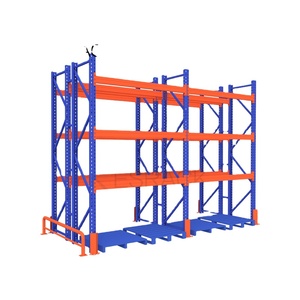
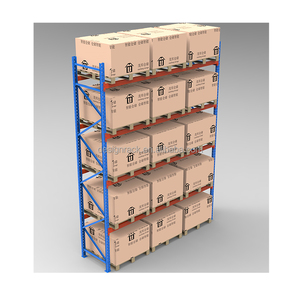
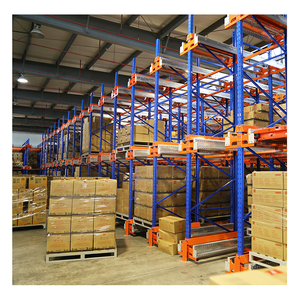
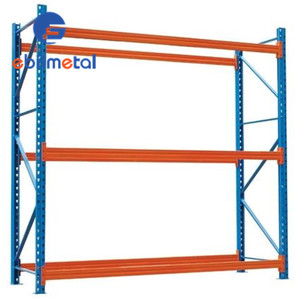
Selective pallet racking remains the universal industry standard, providing 100% direct pallet accessibility. Standard aisles range from 3.5 to 4.0 meters for counterbalanced forklifts, whereas Double-Deep configurations utilize specialized pantograph reach trucks to increase storage density by up to 30% by storing pallets two deep in back-to-back rows.
B. Very Narrow Aisle (VNA) Systems
By contracting operating aisles down to 1.6 – 1.8 meters and utilizing wire-guided or mechanical rail-guided VNA turret trucks, floor area utilization increases by 40-50% while maintaining full vertical storage up to 15 meters.
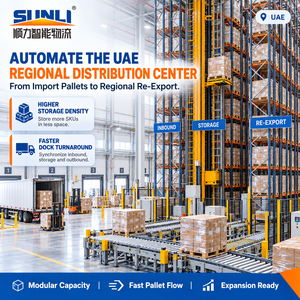
C. High-Density Automated Systems: Radio Shuttle & AS/RS
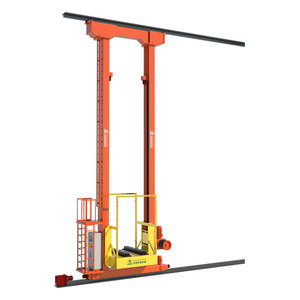
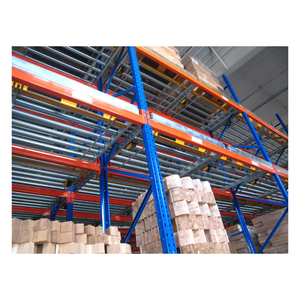
Future-proof logistics relies heavily on semi-automated and fully automated dense storage structures. Automated Radio Shuttle systems deploy wireless-controlled carts that transport pallets inside deep racking tunnels under First-In, Last-Out (FILO) or First-In, First-Out (FIFO) operational modes. For fully automated smart factories, Automated Storage and Retrieval Systems (AS/RS) combine stacker cranes, high-bay structural racking, and Warehouse Control System (WCS) software to achieve continuous, high-speed material flow with minimal manual labor.
4. Future Sourcing & Procurement Trends in Heavy-Duty Bulk Storage (2025–2030)
Global supply chain managers, 3PL operators, and procurement officers must account for key macro-trends reshaping warehouse racking specifications over the coming decade:
Key Sourcing Drivers & Industry Innovations:
- Dark Warehouse & AMR Integration: Racking systems are evolving to integrate seamlessly with Autonomous Mobile Robots (AMRs), automated guided vehicles (AGVs), and overhead monorail systems. This shift requires extremely tight installation tolerances ($\le \pm 1.5\text{mm}$ deflection) and integrated sensor mounts.
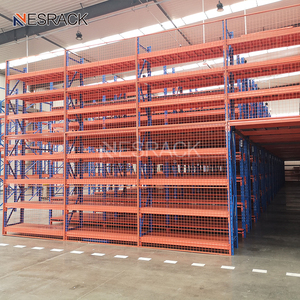
- Modular Mezzanines & Vertical Expansion: As industrial land costs rise globally, warehouse operators prefer expanding vertically via multi-tier structural rack-supported mezzanines rather than relocating facilities.
- Structural Resilience & Seismic Design: Building codes in North America, Europe, and Asia-Pacific increasingly enforce stringent seismic design requirements (per IBC / ASCE 7). Racking engineers must perform Finite Element Analysis (FEA) to design heavy-duty baseplates, expanded anchor bolt patterns, and specialized vertical cross-bracing bays.
- Green Steel & Low-Carbon Supply Chains: Enterprise procurement leads prioritize factory vendors utilizing scrap-based EAF (Electric Arc Furnace) steel production and low-VOC powder coatings to satisfy ISO 14064 carbon reduction reporting mandates.
Request Full Engineering Catalog & Technical Specs
5. Warehouse Layout Calculation Formula & Engineering Framework
To assist facility engineers and procurement managers in estimating theoretical floor space efficiency, our structural team utilizes standardized calculation formulas:
Floor Space Storage Utilization Efficiency ($S_{util}$):
$$S_{util} = \left( \frac{N_{pallet} \times A_{pallet}}{A_{total}} \right) \times 100\%$$
Where $N_{pallet}$ is the total number of pallet positions, $A_{pallet}$ is the footprint area of a standard pallet ($1.2\text{m} \times 1.0\text{m} = 1.2\text{m}^2$), and $A_{total}$ is the gross floor area of the storage warehouse.
Maximum Allowable Beam Deflection ($D_{max}$):
Conforming to ANSI MH16.1 guidelines, maximum beam deflection under full rated load must not exceed:
$$D_{max} = \frac{L}{180}$$
Where $L$ is the clear span length of the racking beam (e.g., for a 2700mm beam, $D_{max} \le 15\text{mm}$).
6. Enterprise Quality Control, Export Packaging & Logistics
Exporting structural steel racks demands robust protective packaging to prevent freight damage during ocean transportation. Our factory enforces rigorous packing standards:
- Bundle Strapping & Edge Guards: Upright frames and beams are bundled using high-tensile steel straps with heavy-duty cardboard edge protectors placed at contact points.
- Moisture & Corrosion Protection: Bundles are wrapped in multi-layer stretch film and vapor-corrosion inhibitor (VCI) protective wraps to prevent surface oxidation during long ocean voyages.
- Container Space Optimization: Using 3D container loading software, components are bundled to match 40ft High Cube (40HC) container dimensions, maximizing ton/cube capacity and reducing sea freight costs per pallet position.
- Identification & Traceability: Every bundle carries a weatherproof label detailing part numbers, bundle weight, production lot numbers, and CAD reference codes for simplified on-site assembly.
Procurement Guidance
Frequently Asked Questions
Direct technical and commercial answers for project managers, engineers, and international sourcing teams.
What structural data is required to design a custom racking layout?
To produce an optimized CAD layout and load matrix, our engineering team requires: (1) Warehouse architectural drawings showing internal dimensions, clear height below trusses, and column spacing; (2) Pallet specifications including dimensions ($L \times W \times H$), load weight, and load overhang; (3) Forklift model, maximum lift height, and turning radius; (4) Local seismic zone data or slab load capacity ($kN/m^2$).
Are your rack profiles compatible with established Western teardrop or Redirack systems?
Yes. We manufacture fully compatible teardrop upright profiles widely used across North America, as well as Redirack-compatible profiles used throughout Canada and Europe. Our engineering team can analyze your existing hole pattern, connector pitch, and beam profile to supply compatible add-on bays or replacement components.
Which international safety and quality certifications do your manufacturing plants hold?
Our production facilities operate under ISO 9001:2015 Quality Management Systems and ISO 14001 Environmental Management Systems. All load calculations and structural designs follow RMI (USA), ANSI MH16.1, FEM 10.2.02, and EN 15635 codes. Full material test certificates (MTC) for steel chemistry and yield strength accompany every shipment.
What surface finish is recommended for sub-zero cold storage facilities?
For cold-storage environments (-10°C to -30°C) or high-humidity facilities, we recommend Hot-Dip Galvanized (HDG) steel components treated to ISO 1461 standards. Hot-dip galvanizing creates a metallurgically bonded zinc alloy layer that resists rust, dynamic thermal cycling, and physical impact without peeling or micro-cracking.
How do you ensure safe installation and regulatory compliance on site?
Every order includes detailed 2D/3D assembly drawings, column anchoring specs, torque specifications for expansion bolts, and safe load warning signs (load plaques) detailing max beam capacity and maximum bay load. We also provide remote engineering consultation or on-site installation supervision upon request.
What is the standard production lead time for FCL container orders?
Standard manufacturing lead time for standard powder-coated selective pallet racking is 14 to 21 days from drawing approval and deposit receipt. Large-scale automated projects or specialized hot-dip galvanized custom orders generally ship within 25 to 35 days.