Factory-direct warehouse racking & material handling equipment — 20+ years of manufacturing experience for global B2B buyers.
Very Narrow Aisle Racking helps warehouses store more pallet positions within the same building footprint. Its aisles are commonly around 1.5–2.0 metres wide, although the required clearance depends on the handling truck, pallet dimensions, and operating conditions. Picture a guided truck turning between tall frames, with only a small margin on either side. The space savings are tangible. So are the design demands.
The MHI 2024 Annual Industry Report found that 55% of surveyed supply chain professionals planned to adopt robotics and automation within five years. That finding reflects wider interest in automation; it is not proof that every site needs very narrow aisles. Before choosing a system, operators should check floor flatness, rack height, fire protection, throughput, and truck compatibility. A denser layout can also make picking less flexible if the aisle plan does not match daily work. This part is easy to underestimate.
Taiichi Ohno, architect of the Toyota Production System, wrote: “All we are doing is looking at the time line, from the moment the customer gives us an order to the point when we collect the cash. And we are reducing that time line by removing the non-value-added wastes.” His principle is not specific to racking, but it offers a useful test: does added storage density improve the whole operation? This guide explains how Very Narrow Aisle Racking works, where it fits, and which trade-offs deserve careful review before installation.
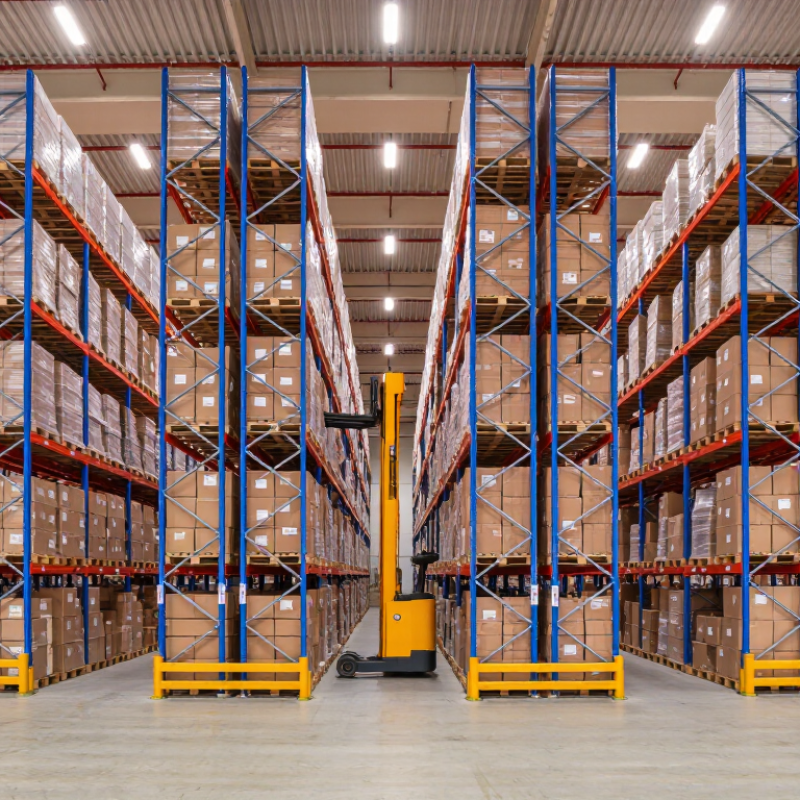
Very narrow aisle (VNA) racking is a storage system designed to fit more pallet positions into a given warehouse footprint. It achieves this by reducing the space between rack rows compared with conventional forklift aisles. The rack structure may look familiar, but operating in the narrower lanes requires suitable equipment, such as a guided turret truck.
Aisle width depends on the truck, pallet dimensions, rack height, and handling clearances. There is no single measurement that suits every warehouse. Guidance systems help trucks travel accurately along each aisle, while careful rack alignment supports safe, repeatable pallet placement. Small errors can matter. A protruding pallet or uneven floor may affect clearances more than expected.
The core principle is to balance storage density with reliable access. Higher racks and narrower aisles can create more pallet positions, but they also place greater demands on floor quality, lighting, operator training, and inventory planning. Before installation, teams should assess actual load sizes, turning requirements, and daily picking patterns. A layout that looks efficient on a plan may feel restrictive during a busy shift. That deserves a second look.
Very narrow aisle racking works by placing pallet storage close together, leaving slim lanes for specialized trucks. The truck travels along a defined aisle and lifts loads into rack bays on either side. Guidance may come from floor rails or a wire embedded in the floor, depending on the equipment and site design. Some trucks can turn their forks to serve both sides without turning the whole vehicle. That saves aisle space. It also demands careful control.
In daily operation, staff bring pallets to the aisle entrance, then a trained operator moves each load to its assigned level. Clear location labels, stable pallets, and unobstructed travel paths help prevent delays. The rack, truck, floor, and load dimensions must be checked together; small mismatches can cause repeated handling problems. Floor flatness matters, especially when loads are lifted high. So does aisle discipline. A loose wrap tail or a pallet that overhangs can become a real obstruction. The layout may look efficient on paper, but busy shifts expose weak points. I would review actual travel patterns before assuming every narrow aisle improves throughput. These systems can increase storage density, yet they also rely on suitable equipment, consistent procedures, and regular inspections. The details matter.
Very narrow aisle (VNA) racking uses closely spaced rows to increase pallet storage within a warehouse. Its main structure includes upright frames, horizontal beams, diagonal bracing, and baseplates fixed to the floor. Beam connectors and safety locks help keep each level secure during daily handling. Small parts matter. A loose connector can affect how the rack performs under load.
The equipment must match the aisle layout. Turret trucks or other VNA-compatible lift trucks reach pallets at height while travelling through narrow lanes. Some systems use floor-mounted guide rails; others use wire guidance built into the floor. Both help keep trucks aligned, but they need careful installation and regular checks. Pallet dimensions, load weights, floor flatness, and turning space all influence the final design. Clear load signs help operators identify safe limits, and trained staff should inspect frames and beams for impact damage. A minor dent may look harmless, though its effect depends on the rack design and location. Measurements taken on an empty floor can also miss practical issues, such as awkward pallet overhang or limited room for maintenance.
Typical operating aisle-width ranges by truck type
Very narrow aisle racking uses high-density storage rows served by specialized VNA turret trucks, often guided by floor rails or wire. The aisle-width ranges shown are indicative; actual requirements depend on the truck model, pallet dimensions, and operating conditions.
What Is Very Narrow Aisle Racking?
Benefits and Limitations
Very narrow aisle racking places pallet rows close together, leaving less floor space for travel lanes. This can create more pallet positions within an existing building. Operators can still access individual loads, which helps when many products turn over at different rates. That matters. The system may suit sites where floor space is expensive and inventory needs frequent, selective access. Aisle dimensions must match the handling equipment, pallet sizes, and load heights. A few centimetres can affect safe, smooth operation.
The trade-off is greater dependence on specialized trucks, careful planning, and consistent operating practices. Equipment may cost more, and a truck problem can restrict work in a narrow aisle. Floors also need suitable flatness; uneven surfaces can affect truck movement and load placement. Congestion can remain an issue if picking routes are poorly planned. Not always. Before installation, warehouse teams should measure real loads, assess traffic patterns, and check applicable safety requirements. A layout that looks efficient on paper may feel awkward during a busy shift. That is worth testing with operators before committing.
| Dimension | Typical VNA Characteristics | Benefits | Limitations and Considerations |
|---|---|---|---|
| Definition | Very narrow aisle (VNA) racking uses closely spaced storage aisles, typically served by specialized trucks such as guided turret or articulated trucks. | Uses warehouse floor space efficiently while retaining access to individual pallet locations in many selective-rack layouts. | Requires a layout and handling equipment designed to work together; standard forklifts may not operate safely or efficiently in the narrow aisles. |
| Aisle width | Often about 1.5–1.8 m (5–6 ft), depending on the truck, load, pallet, and operating clearances. Conventional forklift aisles are commonly wider. | Narrower aisles can leave more of the building footprint available for storage. | There is no universal aisle-width specification. The final width must follow equipment requirements, load dimensions, and safety clearances. |
| Storage capacity | A VNA layout may provide roughly 20–40% more pallet positions than a comparable conventional-aisle layout in some warehouses; actual results vary. | Can increase pallet positions without expanding the building footprint. | Capacity depends on building shape, columns, rack height, staging areas, fire protection, and required access. Narrower aisles alone do not guarantee a particular increase. |
| Pallet access | Often configured for single-deep, selective storage, with access to each pallet location from its aisle. | Supports a broad range of SKUs and direct access to individual pallets, unlike some high-density storage methods. | Selective access can use more space than systems that store multiple pallets deep when SKU count is low and inventory volumes are high. |
| Equipment | Typically needs VNA-capable handling equipment. Guidance may use floor rails, wire guidance, or another system suited to the truck and layout. | Purpose-built equipment can handle loads in narrow aisles and may support high-level storage. | Specialized trucks and guidance infrastructure can increase purchase, maintenance, and training costs. Equipment choice can limit future flexibility. |
| Building and floor | High-bay VNA installations require racks, trucks, and floor conditions appropriate to the intended storage height and operating clearances. | Can make effective use of warehouse height when the building and equipment are designed for it. | Floor flatness, levelness, rack alignment, and installation tolerances may need closer attention, especially in tall installations. |
| Throughput | Order and pallet movement rates depend on travel distances, lift height, truck performance, operator procedures, and warehouse management. | Can perform well in operations that benefit from organized, aisle-based pallet storage and retrieval. | Narrow aisles can constrain simultaneous vehicle movement and may create bottlenecks if traffic, charging, or replenishment is not planned well. |
| Best suited to | Warehouses seeking more pallet positions in a constrained footprint while maintaining selective pallet access. | Can be a strong option when space is costly or limited and the operation can support dedicated equipment. | May be less suitable where low-cost standard trucks, frequent layout changes, or very high multi-pallet-deep density are the primary priorities. |
Note: Aisle widths and capacity comparisons are typical planning ranges, not design guarantees. Confirm final dimensions and performance with the selected handling equipment, rack design, building conditions, and applicable safety requirements.
Very narrow aisle racking suits warehouses that need more pallet positions without expanding the building footprint. Aisles often measure roughly 1.5 to 1.8 metres, but the right width depends on the truck, load size, and operating clearances. It works well for high-density storage and frequent access to individual pallets. A chilled-food warehouse, for example, might use it for fast-moving stock while keeping picking locations close to dispatch. The density comes with a trade-off: standard lift trucks may not operate safely or efficiently in these aisles.
Layout planning starts with the equipment, not just the rack. Check turning and lifting requirements, floor flatness, column positions, sprinkler coverage, and pedestrian routes. Guidance systems may help trucks travel consistently, but they need careful installation and maintenance. MHI’s 2024 Annual Industry Report found that 55% of surveyed supply-chain professionals planned to increase technology investment over the following two years. That shift makes space for charging, system connectivity, and service access worth considering. In practice, these details can be less tidy than a drawing suggests. A misplaced column or uneven floor can restrict usable locations, so a site survey and trial layout matter before installation.
It uses closely spaced rack rows to fit more pallet positions into a warehouse. Access remains selective. Aisles are tighter.
It depends on the lift truck, pallet size, rack height, and handling clearances. There is no universal width. Measure actual loads.
It typically uses turret trucks or other compatible lift trucks. Guidance rails or floor wire help trucks stay aligned. Training matters.
Upright frames, beams, diagonal bracing, and floor-fixed baseplates form the main structure. Connectors and safety locks secure each level. Small parts matter.
Uneven floors can affect truck movement and pallet placement. A floor that looks flat may still create trouble. Check it carefully.
Narrower travel lanes can create more pallet positions in an existing building. Operators can still reach individual loads. Useful, but not magic.
Specialized trucks, careful planning, and consistent operating practices are needed. A truck fault can restrict work in one narrow aisle.
Measure pallets and loads, assess traffic and picking patterns, and confirm turning and maintenance space. Test the layout with operators. Plans can mislead.
Very Narrow Aisle Racking is a high-density warehouse storage system designed to make better use of floor space by reducing the width of aisles between racks. It operates with specialized narrow-aisle lifting equipment that moves through these lanes to access goods stored at height. The system typically includes tall rack structures, guided travel paths, and compatible handling equipment, all planned to support safe and efficient movement.
Its main advantages include increased storage capacity, effective use of vertical space, and organized access to palletized inventory. However, narrow aisles require suitable equipment, careful layout planning, and clear operating procedures; the system may also be less flexible than wider-aisle arrangements. It is most suitable for warehouses with high storage needs and inventory that can be managed in an orderly way. Before installation, planners should consider building dimensions, rack height, aisle width, floor conditions, equipment requirements, and the flow of people and goods.