Factory-direct warehouse racking & material handling equipment — 20+ years of manufacturing experience for global B2B buyers.

0%

Narrow Aisle Pallet Racking has become a practical response to rising warehouse costs, limited floor space, and growing inventory pressure. By reducing aisle widths, this system can increase pallet positions without expanding the building. However, the result depends on more than storage density. Forklift compatibility, beam loading, floor accuracy, rack protection, and operator training all influence real performance.

Industry data supports this shift. MHI’s 2024 Annual Industry Report surveyed more than 1,000 manufacturing and supply chain professionals, highlighting continued investment in automation, digital systems, and workforce productivity. Reports from Grand View Research and Mordor Intelligence also identify warehouse racking as a growing market, driven by e-commerce, third-party logistics, and distribution network expansion. These trends explain why buyers are examining global Narrow Aisle Pallet Racking suppliers more carefully.

A strong supplier should provide more than standard frames and beams. It should offer verified load calculations, layout engineering, seismic considerations, installation guidance, and after-sales support. Field experience matters. A rack that looks efficient on paper may create congestion beside a loading dock or restrict forklift turning near fire exits. Small errors become expensive quickly.

No ranking is perfect. Supplier capabilities vary by region, product category, and project scale. This guide compares leading worldwide providers through practical criteria, including engineering expertise, manufacturing quality, customization, certifications, delivery reliability, and customer support. The aim is not to promote the largest name, but to identify suppliers that can safely convert vertical space into dependable warehouse capacity.
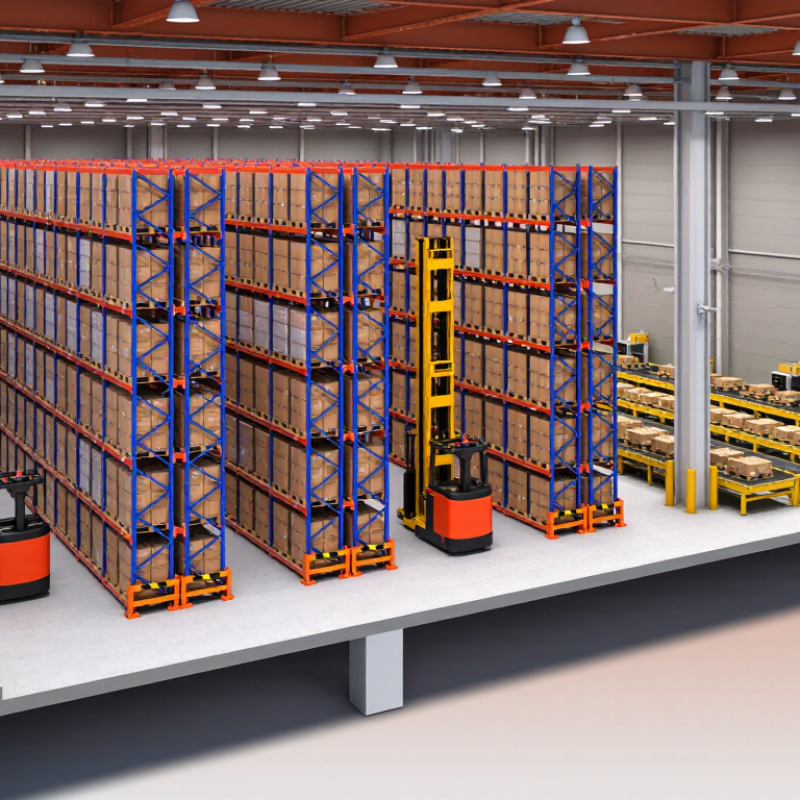
Top Narrow Aisle Pallet Racking Suppliers Worldwide

Definition and Purpose of Narrow Aisle Pallet Racking

Narrow aisle pallet racking is a storage system that reduces the width of forklift travel lanes while keeping pallet loads accessible. Standard forklift aisles often require more room. Narrow-aisle layouts can reclaim floor space for additional rack bays, especially in warehouses with high ceilings and steady pallet movement. They typically need compatible trucks, accurate floor markings, and careful load placement. Small errors matter.

55% of surveyed supply-chain professionals were adopting or evaluating robotics and automation, according to MHI’s 2024 Annual Industry Report.

That figure reflects broader pressure to improve warehouse productivity, not a guarantee that narrow aisles suit every site. In practice, operators should measure truck turning paths, rack heights, floor condition, and emergency access before changing the layout. Aisles that look generous on a drawing can feel tight when a loaded truck turns.

Plan carefully: Narrower is not automatically better. Reduced maneuvering space may slow picking or raise collision risks if training and traffic controls lag. A measured trial in one storage zone can reveal problems before a full redesign.

Key Features and Configuration Options

Narrow aisle pallet racking can recover valuable floor space, but its configuration must match daily work. Typical aisle widths range from about 1.8 to 2.4 meters, depending on truck type and load dimensions. Adjustable beam levels support mixed pallet heights, while guided trucks improve positioning in tight spaces. Upright frames should include impact protection, anchoring, and clearly rated load capacities. Small details matter.

Key configuration options include single-deep and double-deep storage, adjustable beams, wire decking, pallet supports, and back-to-back rows. Double-deep layouts increase density, but they reduce direct access to every pallet. That trade-off deserves careful analysis.

According to the MHI 2024 Annual Industry Report, 55% of surveyed supply chain organizations planned to increase technology and innovation investment.

This supports closer evaluation of warehouse control systems, vehicle guidance, and inventory accuracy before selecting a supplier.

Experienced suppliers should verify slab conditions, ceiling height, fire protection, pallet quality, and equipment turning clearances. They should also provide load calculations and installation documentation, not only attractive capacity charts.

A warehouse drawing can look perfect on paper. Then a damaged pallet arrives. Suppliers with strong engineering processes can recommend guards, mesh panels, reel systems, or carton-flow sections where needed.

However, no configuration is universal. Fast-moving goods may suit selective access, while reserve stock may justify deeper storage. The best choice comes from measured travel paths, real pallet samples, and observed operator behavior—not assumptions.

Criteria for Comparing Global Suppliers

Comparing global suppliers of narrow aisle pallet racking requires more than checking price lists. Site experience matters. A supplier should review aisle width, forklift turning radius, floor condition, pallet dimensions, and expected load cycles. Request measured layouts, structural calculations, and load-test evidence. Generic drawings are rarely enough.

Technical expertise should include compliance with recognized safety standards and local building requirements. Ask who approves the design and how installers are trained. Strong suppliers provide installation records, inspection guidance, replacement procedures, and clear maintenance intervals. Their engineers should explain beam deflection without hiding behind complicated language. Clear answers build confidence.

Reliability appears in less exciting details. Check production capacity, delivery history, spare-part access, warranty limits, and response times across different regions. Speak with recent customers, not only selected references. A neat spreadsheet can still mislead. My own comparisons have sometimes favored a low quotation, then exposed costly delays during installation. That mistake changed my process. I now compare total operating cost, including downtime, inspections, training, and future expansion. Supplier audits also deserve attention, although they can feel intrusive. A factory visit may reveal inconsistent welding, weak labeling, or excellent quality control within minutes. Ask difficult questions early. Some answers will remain imperfect, and that is useful evidence.

Leading Narrow Aisle Racking Suppliers by Region

Top Narrow Aisle Pallet Racking Suppliers Worldwide

Leading Narrow Aisle Racking Suppliers by Region

Regional expertise strongly influences narrow aisle racking performance. In Europe, leading suppliers usually emphasize EN 15635 inspection practices, adjustable beams, and high-bay layouts. These systems suit older warehouses where every square meter matters. In North America, suppliers often design around ANSI MH16.1 guidance, forklift compatibility, and seismic requirements. MHI’s 2024 Annual Industry Report found that 55% of supply chain leaders planned to increase technology investment. That investment also raises expectations for safer, denser storage.

Asia-Pacific suppliers commonly focus on rapid installation, modular components, and high-volume distribution centers. In Japan and South Korea, compact aisles often support automated guided vehicles. In Southeast Asia, corrosion protection and humidity control deserve more attention. Middle Eastern suppliers face dust, heat, and long travel distances between service locations. The right regional partner should provide load calculations, floor checks, installation records, and technician training. A cheaper quote may hide weak after-sales support.

Tips: Compare usable pallet positions, not only rack height. Ask for a site-specific aisle drawing. Verify beam capacity at every level. Request inspection intervals in writing. Check whether local technicians hold recognized training. Small details matter.

A practical warning: very narrow aisles can reduce flexibility when pallet sizes change. This is often overlooked. Test two or three operating scenarios before approving the final layout. MHI data also indicates that technology adoption is accelerating, but manual processes remain common. A rack design should therefore support today’s forklifts, not only tomorrow’s automation.

Top Narrow Aisle Pallet Racking Suppliers Worldwide - Leading Narrow Aisle Racking Suppliers by Region

Region Key Supplier Markets Common Narrow-Aisle System Types Typical Aisle Width Typical Load per Pallet Typical Rack Height Typical Customer Sectors Relevant Standards and Practices
North America United States, Canada, Mexico Selective narrow-aisle pallet racking; VNA-compatible layouts; double-deep configurations 2.4–3.0 m 900–1,800 kg 6–12 m Retail distribution, food and beverage, automotive, third-party logistics ANSI/RMI design practices; local seismic engineering; forklift-specific clearances
Western Europe Germany, Italy, France, Spain, the United Kingdom, Benelux Very-narrow-aisle systems; guided truck layouts; high-bay adjustable pallet racking 1.6–2.0 m 800–1,500 kg 8–14 m E-commerce, industrial manufacturing, pharmaceuticals, grocery logistics EN 15512 structural design; EN 15635 inspection and operational safety practices
Northern Europe Sweden, Denmark, Norway, Finland, the Baltic states High-bay pallet racking; VNA layouts; cold-store narrow-aisle installations 1.7–2.2 m 800–1,500 kg 7–13 m Cold-chain logistics, timber products, food distribution, industrial parts EN 15635 inspections; corrosion protection and low-temperature material considerations
Central and Eastern Europe Poland, Czechia, Slovakia, Hungary, Romania, Austria Selective narrow-aisle systems; high-bay racks; mixed manual and automated storage layouts 1.8–2.5 m 800–1,600 kg 6–12 m Automotive, contract logistics, consumer goods, appliance manufacturing European structural standards; site-specific floor flatness and seismic checks
East Asia China, Japan, South Korea, Taiwan Compact narrow-aisle racking; VNA systems; automated storage and retrieval integration 1.5–2.0 m 500–1,500 kg 6–15 m Electronics, parcel distribution, manufacturing, online retail Local building codes; seismic design in Japan and Taiwan; automated equipment coordination
South Asia India, Bangladesh, Pakistan, Sri Lanka Selective narrow-aisle pallet racking; light-duty mezzanine-supported storage; hybrid layouts 2.2–3.0 m 500–1,500 kg 4–10 m Pharmaceuticals, textiles, spare parts, general warehousing Local engineering codes; floor-load verification; fire-protection coordination
Southeast Asia Singapore, Malaysia, Thailand, Vietnam, Indonesia, the Philippines Narrow-aisle selective racking; cold-storage systems; warehouse automation-ready layouts 2.0–2.8 m 700–1,500 kg 5–12 m Food and beverage, electronics, e-commerce, export manufacturing Regional fire codes; corrosion-resistant finishes; humidity and temperature control
Middle East United Arab Emirates, Saudi Arabia, Qatar, Kuwait, Oman High-bay narrow-aisle racking; cold-store systems; dust-resistant warehouse configurations 2.0–2.8 m 800–1,500 kg 6–14 m Retail distribution, food logistics, spare parts, regional fulfillment centers Gulf-region fire and construction requirements; heat, dust, and sprinkler coordination
Oceania Australia, New Zealand Selective narrow-aisle systems; seismic-rated racks; high-bay distribution layouts 2.4–3.0 m 800–2,000 kg 6–12 m Grocery, mining supplies, agricultural products, third-party logistics AS 4084 design requirements; seismic assessment; mandatory rack inspection practices
Latin America Brazil, Mexico, Chile, Colombia, Argentina Selective narrow-aisle racking; high-density pallet storage; cold-chain configurations 2.2–3.0 m 800–1,800 kg 5–12 m Agriculture, beverage distribution, automotive, retail logistics Local structural and seismic codes; sprinkler clearance and floor-capacity checks
Africa South Africa, Egypt, Morocco, Kenya, Nigeria Selective narrow-aisle systems; medium-height pallet racks; temperature-controlled storage 2.4–3.2 m 600–1,500 kg 4–10 m Consumer goods, food distribution, mining supplies, pharmaceutical logistics Local building and fire codes; corrosion protection; floor and equipment availability assessments

Note: The figures shown are typical industry planning ranges for narrow-aisle pallet-racking applications. Final aisle widths, capacities, heights, anchoring, and compliance requirements must be verified through a site-specific engineering review.

Supplier Selection, Installation, and Safety Considerations

Top Narrow Aisle Pallet Racking Suppliers Worldwide

Selecting a narrow aisle racking supplier requires more than comparing prices. Request stamped load calculations, seismic design assumptions, and installation references for similar warehouses. A reliable supplier should measure slab flatness, clear height, sprinkler locations, and forklift turning paths before quoting. MHI’s 2024 Annual Industry Report reported that 55% of supply chain leaders expected to increase technology investment. That supports using compatible scanning, location control, and fleet data during design. Yet automation cannot correct poor rack geometry. I would challenge any proposal based only on storage density.

Installation quality controls the real safety outcome. Anchors must suit the concrete, frames need plumb checks, and beam locks require visual confirmation. HSE’s HSG76 guidance recommends regular inspections, with expert inspections at least every twelve months. OSHA’s powered industrial truck rules also require operator training and workplace-specific evaluation. Narrow aisles leave less recovery space. One damaged upright can affect an entire bay. This is where many projects become complacent.

Tips: Mark pedestrian crossings clearly. Photograph every anchor row. Record beam levels after loading. Train operators beside the actual rack layout, not only in a classroom. Review near misses monthly. Leave room for mistakes; a perfect drawing rarely matches a busy warehouse. Suppliers should provide inspection forms, replacement-part details, and written load notices. Ask who owns each safety check after handover.

FAQS

What should suppliers inspect before designing narrow aisle pallet racking?

They should measure aisle width, forklift turning radius, floor condition, pallet sizes, and clear ceiling height. A site-specific layout matters. Generic drawings often miss sprinkler locations and uneven slabs.

Which technical documents should buyers request?

Request structural calculations, measured layouts, beam capacity data, and load-test evidence. Ask who approves the design. Clear explanations build trust.

How can regional conditions affect rack design?

Climate and building practices change the requirements. Humid areas need stronger corrosion protection. Hot, dusty locations need careful maintenance planning. Earthquake-prone areas require suitable structural calculations.

How should buyers compare supplier prices?

Compare total operating cost, not only the quotation. Include delivery delays, inspections, training, downtime, and future expansion. A cheap quote can become expensive.

What installation checks are important?

Confirm suitable anchors, upright alignment, beam locks, and frame plumbness. Photograph each anchor row. Record beam levels after loading.

How often should pallet racking receive expert inspection?

Arrange regular internal checks and expert inspections at least every twelve months. Review damaged uprights immediately. One impact can affect an entire bay.

What should operator training include?

Train operators beside the actual rack layout, using the real forklifts and aisle conditions. Cover turning paths, load placement, pedestrian crossings, and damage reporting. Classroom training alone feels incomplete.

Can very narrow aisles create problems later?

Yes. They may reduce flexibility when pallet sizes, forklifts, or workflows change. Test several operating scenarios before approval. My earlier comparisons sometimes favored density too quickly.

What after-sales support should a supplier provide?

Check spare-part access, warranty limits, response times, inspection forms, and replacement procedures. Ask who owns each safety check after handover. Written answers are better.

Conclusion

Narrow Aisle Pallet Racking is a high-density storage solution designed to maximize warehouse capacity while maintaining organized access to palletized goods. By reducing aisle widths compared with conventional systems, it allows businesses to use more vertical and floor space efficiently. Typical configurations may include adjustable beam levels, tall upright frames, guided or specialized handling equipment, and layouts tailored to pallet dimensions, load weights, building height, and inventory turnover.

When comparing global suppliers, companies should evaluate product quality, engineering capability, customization options, delivery reliability, installation support, after-sales service, and compliance with applicable safety standards. Regional supplier selection should also consider local experience, technical resources, spare-parts availability, and communication efficiency. Before installation, the facility should undergo a detailed site assessment covering floor conditions, clearances, equipment movement, fire protection, and structural loads. Proper training, routine inspections, load labeling, damage reporting, and safe operating procedures are essential to preserve system performance and protect warehouse personnel.


Elowen

Elowen

Elowen is a seasoned marketing professional with a strong understanding of the company’s products, customers, and market dynamics. Through a combination of strategic thinking, clear communication, and practical industry knowledge, Elowen helps translate complex product capabilities into valuable......