Factory-direct warehouse racking & material handling equipment — 20+ years of manufacturing experience for global B2B buyers.
Selective Pallet Racking is one of the most widely used storage systems in modern warehouses. It gives forklifts direct access to individual pallets, making stock retrieval faster and easier to organize. In a typical installation, upright frames support horizontal beams. Pallets rest on these beams across several adjustable levels. The aisle layout influences how efficiently people and equipment can move.
The system follows a straightforward loading pattern. Operators place pallets into open rack positions from the aisle. They can remove each pallet without moving others. This “first-in, first-out” assumption can be misleading. Selective Pallet Racking offers direct access, but it does not automatically guarantee stock rotation. Warehouse teams still need clear labels, disciplined picking, and suitable inventory procedures.
A practical assessment should examine pallet dimensions, load weights, forklift reach, aisle width, and ceiling height. Beam capacity and floor conditions also matter. Small errors can create serious instability. I have seen layouts look efficient on paper yet slow down when turning space is too tight. That lesson is easy to overlook. Reliable planning combines manufacturer specifications, trained installation, routine inspections, and realistic traffic observations. The following guide explains how Selective Pallet Racking is built, how pallets move through it, and where its strengths become limitations. It also considers safety decisions that deserve closer review, because the cheapest layout may not be the most dependable one.
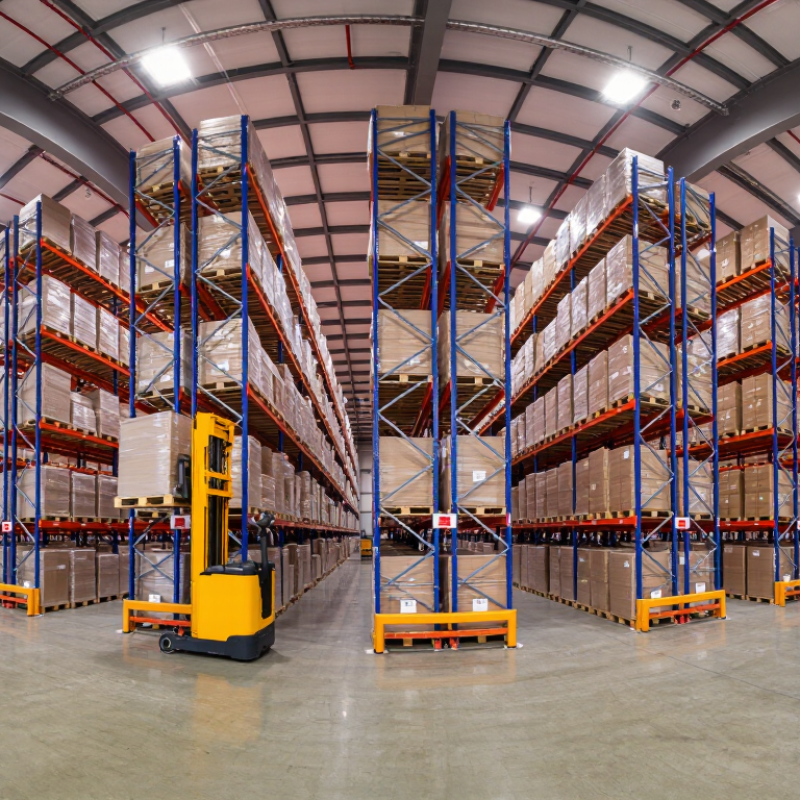
Selective pallet racking is a warehouse storage system designed for direct access to individual pallets. Each pallet sits on horizontal beams within a steel frame. Forklifts can reach a specific load without moving the pallets stored above or beside it. This arrangement suits warehouses handling many product types, moderate quantities, and frequent stock rotation.
The system is designed to store palletized goods with consistent dimensions and verified weights. Typical loads include boxed products, packaged food, spare parts, building materials, and industrial supplies. Pallets should remain stable on the beams, with no damaged boards, loose wrapping, or uneven weight distribution. Clear load labels help operators match each position with the correct capacity.
In practice, rack depth, beam height, aisle width, and forklift reach must match the warehouse and pallet measurements. A common planning mistake is focusing only on maximum storage capacity. Access speed matters too. Narrower aisles may add positions but can slow daily handling. I have also seen layouts fail when seasonal inventory was ignored. Adjustable beams provide flexibility, yet they do not remove the need for regular inspections. Check uprights, connectors, beams, anchors, and pallet condition. Small damage can become expensive. The safest design uses accurate load data, trained operators, and documented maintenance checks.
Selective pallet racking is designed to store palletized goods on horizontal beams, with direct forklift access to every pallet position. The chart compares common pallet footprints that can be stored in a selective racking system.
How it works: Upright frames support adjustable beams, creating individual pallet locations across multiple levels. The required rack depth, beam length, load capacity, and clearance must be matched to the pallet dimensions and stored load.
Selective pallet racking uses upright frames and horizontal beams to create adjustable storage bays. Each bay holds pallets on beam levels, while forklifts access every pallet directly. This layout suits warehouses with many stock-keeping units and moderate turnover.
The main structural parts are uprights, beams, bracing, baseplates, anchors, and pallet supports. Uprights transfer vertical loads to the floor. Beams connect the frames and carry pallet weight. Diagonal bracing keeps the frame stable, although it does not replace proper anchoring. ANSI MH16.1, referenced by the Rack Manufacturers Institute, provides design guidance for industrial steel storage racks. OSHA 1910.176 also requires stored materials to remain stable and secure.
Small details matter. Beam connectors must seat correctly. Damaged frames need immediate isolation, not hopeful inspection.
A practical layout usually places rack rows parallel to forklift travel. Aisle width depends on the truck type, pallet dimensions, turning radius, and emergency access needs. MHI’s 2024 Annual Industry Report, based on responses from more than 1,000 industry professionals, identifies workforce pressure as a major operational challenge. That supports simpler rack layouts and clearer labeling. However, density should not be the only goal. A narrow aisle may add capacity but reduce maneuvering tolerance. In real warehouses, floor unevenness, uneven pallet loads, and changing inventory often expose design assumptions. Load plaques, routine inspections, and visible impact protection help, but they are not perfect substitutes for trained review.
Selective pallet racking stores pallets on individual beam levels, giving forklifts direct access to every load. That access makes it practical for warehouses handling many stock-keeping units with changing demand.
A forklift approaches the rack squarely and lifts a pallet above the selected beam. The operator then moves forward slowly, checking pallet condition and clearance. The pallet slides onto the beams, where both beams must support it evenly. A warehouse management system records the location, quantity, and product batch.
Location accuracy matters. The 2024 MHI Annual Industry Report identifies inventory visibility and warehouse efficiency as major investment priorities for supply-chain leaders. Yet software cannot correct a damaged pallet or a wrong scan.
Retrieval follows the reverse path. The forklift enters the aisle, raises the forks slightly, and takes the pallet weight before pulling outward. The operator lowers it only after clearing the rack. Many facilities use first-in, first-out rules for dated goods, while others select pallets by order priority.
The U.S. Bureau of Labor Statistics recorded 1,069 fatal work injuries in transportation and material-moving occupations in 2023, showing why controlled movement remains essential. Small details matter: clear aisle markings, visible load limits, and routine rack inspections. A perfect plan still meets an imperfect pallet. That is where training and judgment matter.
Selective pallet racking is a storage system with upright frames and horizontal beams. It gives forklifts direct access to each pallet position. This arrangement supports many product types and frequent stock rotation. A practical layout must match aisle width, ceiling height, pallet dimensions, and forklift turning space. Every inch matters.
Safe performance depends on more than steel beams. Uprights, beams, braces, anchors, and wire decking must suit the planned load. Load signs should display maximum weights at visible points. Inspect the structure before each shift when damage risks are high. Look for bent frames, loose anchors, missing safety pins, and damaged decking. Keep aisles clear. Forklift operators need controlled speeds, clear sightlines, and properly maintained vehicles. Pallets should sit evenly on beams, not hang dangerously over the edges.
Pedestrian routes should be separated from forklift travel whenever possible. Place heavier pallets on lower levels to reduce instability. Never climb the racking. A damaged beam should be isolated and assessed by a qualified person before reuse. Local safety requirements and the rack designer’s load data should guide every modification. In real warehouses, rushed replenishment can weaken good procedures. I have seen small problems become expensive hazards because inspections felt inconvenient. That gap matters. Details matter.
What Is Selective Pallet Racking and How Does It Work?
Selective pallet racking is a direct-access storage system. Each pallet sits on horizontal beams between upright frames. Forklifts can reach every pallet without moving others. That simple layout suits warehouses with many stock-keeping units and frequent product movement.
Its main advantage is accessibility. Operators can inspect labels, rotate inventory, and replenish individual locations quickly. It also uses adjustable beam levels, helping facilities store cartons, drums, or mixed pallet heights. However, the system usually provides lower storage density than drive-in or mobile alternatives. Aisles consume valuable floor space. Poor load placement can also create unstable conditions. The weak point is often daily discipline.
The Rack Manufacturers Institute standard ANSI MH16.1 stresses proper design, loading, and inspection practices. These details matter because beam capacity depends on spacing, connection design, and pallet loads. WERC’s 2024 DC Measures Report lists median order-picking accuracy at 99.5%, but racking alone cannot create that result. Clear labels and disciplined scanning remain essential. MHI’s 2024 Annual Industry Report found that 55% of supply-chain professionals expect greater robotics and automation use within one to two years. Selective racks can support that transition, but aisle width and rack geometry must be reviewed carefully. A neat layout can still perform badly. Warehouses should measure travel distance, damage rates, utilization, and replenishment time before expanding the system.
| Dimension | Key Information | Typical Data or Practical Detail | Operational Implication |
|---|---|---|---|
| Definition | Selective pallet racking is a beam-and-upright storage system that holds palletized goods in individual storage locations. | Each pallet position is generally accessible from the warehouse aisle without moving other pallets. | It provides high selectivity and is suitable when many stock-keeping units require direct access. |
| Basic Structure | The system is assembled from upright frames, horizontal load beams, pallet supports, row spacers, and protective accessories. | Beam levels are adjusted vertically to match pallet height, load height, and required clearance. | The modular design allows storage levels and bay configurations to be changed as inventory requirements evolve. |
| How It Works | A forklift places pallets onto the horizontal beams and retrieves them from the aisle-facing side. | Loading and retrieval normally occur from the same aisle, unless the layout includes separate travel or transfer aisles. | Operators can locate and handle individual pallets without first removing surrounding loads. |
| Storage Access | Direct access is available to every pallet location, provided the aisle and equipment clearances are maintained. | Access is commonly described as 100% pallet selectivity, subject to safe operating conditions and unobstructed aisles. | This is advantageous for mixed-SKU inventories, order picking, and frequent replenishment. |
| Stock Rotation | The rack itself does not force a stock-rotation method; warehouse procedures determine the sequence of pallet movement. | FIFO can be supported through disciplined location management and separate loading and unloading processes. LIFO may occur when the newest accessible pallet is retrieved first. | Inventory-control software, labeling, and operator procedures are important when expiration dates or batch rotation matter. |
| Typical Aisle Requirement | Aisle width depends on the forklift type, turning radius, pallet dimensions, rack height, and facility layout. | Conventional counterbalance-forklift layouts often require approximately 3.0–3.7 m aisles; reach-truck layouts may use narrower aisles, commonly around 2.4–2.9 m. | The selected handling equipment should be confirmed before finalizing the rack layout. These figures are planning ranges, not universal requirements. |
| Load Capacity | Capacity is determined by upright-frame design, beam size, beam spacing, pallet configuration, and the number of storage levels. | Many industrial systems are engineered for several hundred kilograms to several tonnes per beam level, but the exact safe working load must come from the design calculation and supplier documentation. | Loads must never exceed posted capacity ratings, and beam capacities should not be assumed from appearance alone. |
| Space Utilization | Selective racking uses vertical space efficiently but reserves a substantial amount of floor area for access aisles. | Overall warehouse cube utilization is commonly lower than in high-density systems because every pallet location needs forklift access. | It is often preferred when product variety and accessibility are more important than maximum storage density. |
| Primary Advantage | High selectivity and straightforward pallet access. | Every pallet can normally be reached directly without deep-lane excavation or pallet shuffling. | Picking, replenishment, cycle counting, and inventory inspection are easier to organize. |
| Additional Advantages | The system is modular, scalable, visible, and widely compatible with standard warehouse forklifts. | Beam levels can be reconfigured; damaged components can often be replaced individually; open construction improves product visibility. | It can support phased expansion and relatively simple changes to SKU quantities or pallet profiles. |
| Main Limitation | Storage density is lower than that of many drive-in, push-back, pallet-flow, or automated high-density systems. | Aisles occupy floor space and reduce the number of pallet positions that can fit within a fixed building footprint. | Selective racking may be less suitable when a facility stores large volumes of a small number of SKUs. |
| SKU Suitability | Best suited to operations with many SKUs, variable demand, and a need to access individual pallets. | Common examples include spare parts, packaged food, general merchandise, industrial supplies, and wholesale distribution. | It supports broad product variety better than systems designed primarily for deep storage of one SKU per lane. |
| Forklift Dependency | Forklifts or other approved lift trucks are normally required to place and retrieve pallets at elevated levels. | Equipment selection affects aisle width, maximum lift height, pallet compatibility, throughput, and operator visibility. | Rack design and material-handling equipment should be planned as one integrated system. |
| Safety Requirements | Safe operation requires rated components, suitable floor conditions, proper installation, load identification, and routine inspection. | Important controls include upright guards, end-of-aisle protection, beam locks, visible capacity signs, impact reporting, and keeping aisles clear. | Local building, fire, seismic, occupational-safety, and engineering requirements must be reviewed before installation and use. |
| Fire and Clearance Planning | Rack layout must account for sprinkler coverage, flue spaces, building columns, emergency routes, and required clearances. | Clearance values vary according to building codes, commodity classification, sprinkler design, rack height, and storage arrangement. | Fire-protection requirements should be verified with a qualified designer or the relevant authority rather than estimated from a generic rule. |
| Common Applications | Selective racking is widely used in distribution centers, manufacturing warehouses, retail backrooms, cold-storage facilities, and third-party logistics operations. | It is especially practical where pallet access, SKU variety, and flexible location assignment are recurring operational priorities. | The system can function as reserve storage, replenishment storage, or a combination of reserve and picking locations. |
| Best-Fit Operating Profile | Facilities with moderate-to-high SKU variety, frequent pallet movement, and changing inventory levels. | Suitable when access frequency and location flexibility outweigh the need for the highest possible pallet density. | It offers a balanced solution between capital simplicity, accessibility, scalability, and operational control. |
| When to Consider Alternatives | Alternative systems may be preferable when pallet density, temperature-controlled capacity, or automated throughput is the dominant objective. | Drive-in or push-back systems support deeper storage; pallet-flow systems can improve FIFO movement; automated systems can reduce manual travel in suitable facilities. | The choice should be based on SKU count, inventory turns, pallet dwell time, required selectivity, building dimensions, labor, and capital budget. |
Planning figures are typical industry ranges for orientation only. Final rack dimensions, load ratings, aisle widths, clearances, and safety provisions must be confirmed through site-specific engineering and applicable local regulations.
It stores palletized goods with consistent dimensions and verified weights. Common examples include boxed products, packaged food, spare parts, and building materials.
Each pallet rests on horizontal beams between upright frames. A forklift can reach one pallet without moving nearby loads.
It suits facilities with many product types, moderate quantities, and frequent stock rotation. Every pallet location stays individually accessible.
Pallets should have sound boards, secure wrapping, and balanced weight distribution. A leaning or damaged pallet needs attention before storage.
Check pallet dimensions, rack depth, beam height, aisle width, ceiling height, and forklift turning space. A compact layout can still slow daily work.
Inspect uprights, beams, braces, connectors, anchors, safety pins, and decking. Look for bent frames, loose anchors, or missing components.
Place pallets evenly across the beams, without dangerous overhang. Store heavier pallets on lower levels to improve stability.
No. Aisles use valuable floor space, so denser systems may hold more pallets. However, they often reduce direct access.
Adjustable beams provide useful flexibility, but changes need qualified review. Load data, aisle clearance, and local safety requirements still matter.
Measure travel distance, replenishment time, damage rates, utilization, and picking accuracy. More pallet positions do not always mean better performance.
Selective Pallet Racking is a versatile warehouse storage system designed to hold palletized goods while providing direct access to each pallet position. Its structure typically includes upright frames, horizontal beams, base plates, and safety components arranged in parallel rows with aisles between them. This layout allows warehouses to use vertical space efficiently while keeping inventory organized and visible.
Pallets are loaded onto the beams using suitable material-handling equipment, positioned securely, and retrieved when needed according to warehouse procedures. Safe operation requires trained personnel, proper load distribution, regular inspections, clear aisle markings, and appropriate protective equipment. The main advantages of Selective Pallet Racking are easy product access, flexible storage, and straightforward inventory management. However, it may offer less storage density than systems designed for high-volume, same-product storage. It is commonly used in distribution centers, manufacturing facilities, retail warehouses, and general storage environments.