Global buyers are entering 2026 with tighter warehouse footprints, more volatile inventory, and higher expectations for order speed. Adjustable Pallet Racking remains a practical foundation because beam levels can change as products, pallets, and handling equipment change. Selective, narrow-aisle, double-deep, drive-in, and push-back systems each solve different storage problems. None is universally superior.
Grand View Research reports continued expansion in the global warehouse racking market, supported by e-commerce, manufacturing growth, and distribution investment. MHI’s 2024 Annual Industry Report also highlights sustained spending on supply-chain technology and operational resilience. These trends matter. A rack system is not only steel; it affects travel distance, forklift access, fire protection, pallet compatibility, and future capacity. For example, a selective rack may offer direct access to every pallet, while a double-deep design can increase density but reduce immediate accessibility.
Warehouse design researcher John J. Bartholdi III states, “The objective of storage is to minimize the total cost of handling and storage.” His principle remains useful when comparing 2026 racking options. Buyers should test aisle widths, load ratings, seismic conditions, local standards, and installation quality before choosing a supplier. EN 15635 guidance and regional safety requirements should inform inspections and ongoing maintenance.
The numbers can look convincing.
Still, projections are not guarantees. A high-density system may appear efficient on a layout but perform poorly during peak picking hours. This overview examines the leading Adjustable Pallet Racking types for global buyers, using practical warehouse conditions rather than marketing claims alone. The right answer may be less automated, more accessible, and easier to adapt.
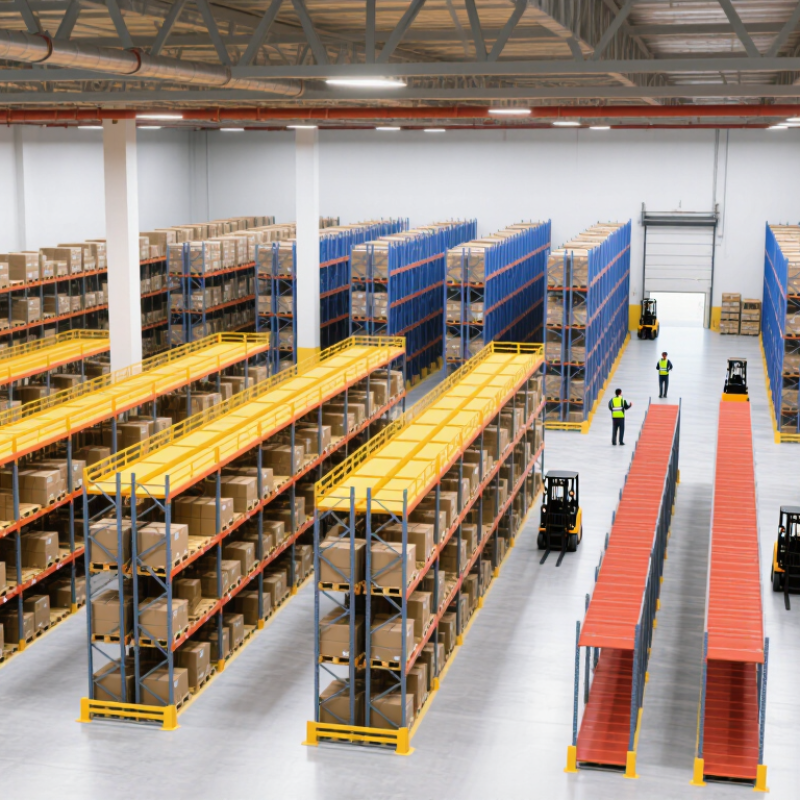
What Adjustable Pallet Racking Is and How It Supports Global Warehousing
Adjustable pallet racking uses upright frames and movable horizontal beams to store palletized goods at different heights. Operators can change beam positions as carton sizes, pallet weights, and inventory profiles change. Selective racking offers direct access to every pallet. Drive-in systems increase density, while double-deep, push-back, pallet-flow, narrow-aisle, and mobile designs serve different warehouse priorities.
This flexibility supports global warehousing, where products and handling equipment vary by region. A buyer may need wider aisles for counterbalance forklifts in one facility, but narrow-aisle trucks in another. Local seismic conditions, floor capacity, fire protection, and inspection rules also affect the design. MHI’s 2024 Annual Industry Report indicates that 55% of supply-chain professionals expect to adopt robotics and automation within one or two years. Adjustable racks can provide the stable storage grid that automation depends on, but beam levels must match robotic reach and pallet tolerances.
Density is not always efficiency. The 2024 DHL Logistics Trend Radar highlights robotics and artificial intelligence as important logistics trends, yet technology cannot repair poor slotting. A high-density drive-in layout may reduce travel, but it can slow access to mixed-SKU inventory. Buyers should compare occupancy, selectivity, load ratings, aisle width, and future expansion. One assumption often fails: the cheapest rack is rarely the lowest-cost warehouse solution. Plain load labels, impact protection, and scheduled inspections remain essential.
2026 Top Adjustable Pallet Racking Types for Global Buyers - What Adjustable Pallet Racking Is and How It Supports Global Warehousing
A practical comparison of adjustable pallet racking configurations, operating characteristics, capacity ranges, and typical warehouse applications.
| Racking Type |
How It Works |
Typical Selectivity |
Typical Bay Load |
Typical Height Range |
Best For |
Main Consideration |
| Selective Pallet Racking |
Adjustable horizontal beams create individual pallet locations accessible from the aisle. |
100% |
Typically 2,000–5,000 kg |
3–12 m |
Mixed SKUs, frequent picking, and general distribution centers. |
Requires more aisle space than dense-storage systems. |
| Narrow-Aisle Adjustable Racking |
Selective racks are installed in reduced aisles and served by specialized narrow-aisle equipment. |
100% |
Typically 2,000–4,500 kg |
6–15 m |
High-density warehouses with expensive or limited floor area. |
Equipment and floor-flatness requirements are higher. |
| Double-Deep Racking |
Two pallet positions are stored one behind another, normally using a reach truck. |
Approximately 50% |
Typically 2,000–5,000 kg |
4–12 m |
Medium-turnover inventory with several pallets per SKU. |
Front pallets can block access to rear pallets. |
| Drive-In Racking |
Forklifts enter storage lanes supported by rails; pallets are stored in depth. |
Low; usually one SKU per lane |
Typically 1,000–3,000 kg per pallet position |
4–10 m |
High-volume, low-SKU inventory and temperature-controlled storage. |
Lower selectivity and greater forklift impact risk. |
| Push-Back Racking |
Pallets rest on nested carts or rollers and move backward when a new pallet is loaded. |
Approximately 50–75% |
Typically 1,000–3,000 kg per pallet position |
4–10 m |
Medium-turnover goods requiring greater density than selective racks. |
Usually operates on a last-in, first-out basis. |
| Pallet Flow Racking |
Inclined roller lanes move pallets from the loading side toward the picking side. |
100% by SKU lane |
Typically 1,000–2,500 kg per pallet position |
3–10 m |
First-in, first-out rotation, food, beverages, and date-sensitive products. |
Roller maintenance and pallet quality affect performance. |
| Mobile Pallet Racking |
Rack rows are mounted on powered bases that open only the required access aisle. |
Up to 100% when the required aisle is opened |
Typically 2,000–5,000 kg |
3–12 m |
Cold stores, archives, and facilities where floor space is costly. |
Higher capital cost and greater dependence on electrical systems. |
| Shuttle-Assisted Racking |
A battery-powered shuttle moves pallets within deep storage lanes while forklifts remain at the lane entrance. |
Medium to high by lane |
Typically 1,000–2,000 kg per pallet position |
4–12 m |
High-volume operations seeking dense storage and reduced forklift travel. |
Requires battery management, controls, and technical maintenance. |
Planning note:
Capacity, height, beam spacing, aisle width, pallet dimensions, seismic design, fire protection, and local safety requirements must be verified for each project. The ranges above are general planning benchmarks rather than engineering specifications.
Adjustable beam levels
SKU flexibility
Scalable warehouse layout
Global pallet compatibility
Inventory accessibility
Key Structural Components and Operating Principles of Adjustable Pallet Racks
Adjustable pallet racking remains a practical choice for global warehouses in 2026.
Its main structure uses upright frames, horizontal beams, diagonal bracing, base plates, anchors, and pallet supports. Uprights carry vertical loads. Beams transfer pallet weight across each bay. Wire decking or pallet supports reduce the risk of unstable placement.
The operating principle is simple.
Beams lock into punched upright holes with safety pins. Workers can change beam levels to suit different pallet heights. This flexibility improves storage density while keeping each pallet directly accessible. A 1.2-meter pallet may need more than its own height; clearance protects products during forklift handling.
Load plaques should show bay capacity, beam capacity, and permitted pallet positions. Small labels prevent large mistakes.
The MHI 2024 Annual Industry Report reported that 55% of surveyed supply-chain professionals increased technology investment.
That trend supports better rack inspections, digital inventory control, and safer material handling.
However, software cannot correct a bent upright or missing beam connector. Field inspections should check anchors, frame plumb, beam locks, impact damage, and overloaded levels.
ANSI MH16.1 provides recognized design guidance for steel pallet racks in North America, while local seismic and building rules may differ.
In practice, adjustable racks are not automatically safer. Poorly trained operators, uneven floors, and unclear load data still create weak points.
Some warehouses also overestimate usable capacity because aisles, fire protection, and forklift turning space consume valuable floor area.
Main Adjustable Pallet Racking Types for Different Storage Requirements
2026 Top Adjustable Pallet Racking Types for Global Buyers
Main Adjustable Pallet Racking Types for Different Storage Requirements
Selective pallet racking remains the practical baseline for mixed inventory. Each pallet is directly accessible from an aisle. It suits warehouses with many stock-keeping units and frequent picking. Beam levels can be adjusted as carton heights change. MHI’s 2024 Annual Industry Report surveyed more than 1,700 supply-chain professionals. It found that 55% planned to increase technology and innovation investment. Adjustable racks support that transition without requiring full automation.
Double-deep racking stores pallets behind one another, improving storage density. It works better when products have fewer variations and longer replenishment cycles. Drive-in racking offers deeper lanes and high utilization. However, forklift access becomes less flexible. Push-back racking uses nested carts and supports several pallets per lane. Pallet-flow racking uses gravity rollers, making first-in, first-out rotation easier for food, beverage, and dated goods. Small detail. Roller maintenance matters.
Cantilever racking is more suitable for timber, pipes, and other long loads. It needs careful load assessment and clear aisle planning. The Rack Manufacturers Institute’s ANSI MH16.1 standard provides design and safety guidance for industrial steel storage racks. Yet a compliant system can still perform poorly if operators ignore actual pallet dimensions. Global buyers should check seismic conditions, floor capacity, forklift turning radius, and local inspection requirements. A tidy layout is not always an efficient one.
2026 Top Adjustable Pallet Racking Types for Global Buyers
Main adjustable pallet racking types for different storage requirements
The chart shows representative working-load ranges per pallet position commonly used in industrial warehouse planning. Actual capacity depends on rack height, beam length, pallet dimensions, steel specifications, seismic requirements, and local regulations.
How to Compare Rack Capacity, Compatibility, Safety, and Accessibility
Adjustable pallet racking remains a practical choice for warehouses with changing inventory.
Compare capacity using real pallet weights, not average estimates. Record each pallet’s height, load shape, and center of gravity. A three-level rack may support different loads at each beam position. Beam length, upright height, steel profile, and floor condition all affect performance. Ask for tested load tables and clear installation limits. A spreadsheet can still lie when measurements are incomplete.
Compatibility begins with the pallet and handling equipment.
Check pallet entry openings, beam clearances, fork reach, and upright spacing. A narrow-aisle layout saves floor space but may require specialized trucks. Standard forklifts need enough turning room near rack ends. Uneven pallets can catch on beams. I have seen small dimensional errors reduce usable storage more than expected. Recheck measurements with a loaded pallet.
Safety deserves practical inspection.
Use column guards where trucks operate, secure beams against accidental release, and keep damaged members out of service. Mark every bay with its maximum permitted load. Local building, fire, seismic, and workplace requirements may differ, so a qualified professional should review the design. Accessibility also affects daily productivity. Leave clear routes for pedestrians, emergency access, and maintenance. Higher storage is not always better. If workers cannot inspect labels or retrieve pallets safely, theoretical capacity becomes wasted capacity. Photograph the proposed layout and test one representative bay before expanding the system.
Global Buying Factors: Standards, Customization, Shipping, and Installation
Global buyers choosing adjustable pallet racking in 2026 should begin with local compliance, not price. Selective, double-deep, drive-in, and narrow-aisle systems suit different inventory patterns. EN 15635 supports regular rack inspections, while ANSI MH16.1 addresses design requirements in the United States. Australia uses AS 4084 for steel storage racking. These standards are not interchangeable. A rack designed for one seismic zone may require stronger frames, anchors, or bracing elsewhere.
Customization should reflect real operating conditions. Buyers should provide pallet dimensions, unit loads, forklift clearances, beam levels, floor tolerance, and expected growth. A 2.7-meter aisle can change the required handling equipment. The World Bank’s 2023 Logistics Performance Index compares 139 economies and highlights infrastructure, customs, and shipment reliability as major logistics factors. Therefore, a low-cost rack can become expensive when local delivery access is poor. Small details matter.
Shipping plans also need engineering review. UNCTAD reports that maritime transport carries over 80% of global merchandise trade by volume. Container limits, corrosion protection, packing volume, and port congestion can affect the final cost. Installation should include approved drawings, torque checks, anchoring, load plaques, and trained supervisors. OSHA requires storage equipment to be used within its safe capacity. A drawing can still lie. Site measurements sometimes expose design mistakes. Buyers should allow time for inspection, replacement parts, and worker training, rather than treating installation as a simple assembly task.
Conclusion
Adjustable Pallet Racking is a flexible and efficient storage solution designed for warehouses that handle different pallet sizes, weights, and inventory volumes. Its adjustable beams, upright frames, bracing, base plates, and safety accessories work together to create stable storage levels that can be reconfigured as operational needs change. Common types include selective pallet racking for direct access, drive-in systems for high-density storage, double-deep layouts for increased capacity, and specialized configurations for specific handling equipment or warehouse conditions.
When selecting a system, global buyers should compare load capacity, pallet and forklift compatibility, accessibility, space utilization, durability, and workplace safety features. International purchasing also requires attention to applicable standards, local building requirements, customization options, packaging, shipping arrangements, and professional installation. A well-planned Adjustable Pallet Racking solution can improve inventory organization, support safer material handling, and provide long-term flexibility for warehouses operating across different markets.




